Sunday, March 10, 2013

Weekend Recap: The highs and lows of racing

This weekend recap will encompass two weekends. Last weekend was particularly noteworthy, but as Limerick's colic still besieged my thoughts, I was not yet up to writing a weekend recap at that time.

Here are my two favorite performances of last weekend. March 2 was overall an excellent day of racing.

Tom Fool (Gr. III)  "Best effort of 2013!" Unlike the Santa Anita Handicap, on this day the Tom Fool wasn't a race I was eagerly looking forward to. But it would become the most gutsy race I'd seen so far in 2013. A gelding of the 2008 foal crop, Comma to the Top is one of those consistent racehorses that you can't help but enjoy watching. He puts his share of work in, but is usually not one to dazzle. He broke his own mold on Saturday, March 2.

Making his second start in a week, he led the Tom Fool field through respectable fractions of :22.92 and :46.29. Halfway down the stretch, he was swarmed by a wall of horses from behind and appeared beaten. The gray Head Heart Hoof challenged for the lead and Comma to the Top stubbornly hung on. But then Saturday's Charm came flying down on the outside of Head Heart Hoof and for the second time in the race, I was certain Comma to the Top was beaten. After all, horses don't usually see outside late closers in a situation like this. Saturday's Charm seized the lead but Comma to the Top wasn't finished. With a few short strides to the wire, he battled back valiantly and, unbelievably, thrust his nose in front. The race left me breathless and I immediately texted my husband, who was at work, "Wow, you gotta see the Tom Fool replay. I've rarely seen a more gritty performance!" The 2013 Tom Fool is one of those races that you file away in the memory banks within easy reach, and reference time and time again as the years go by. Click here for a can't-miss race video.

Santa Anita Handicap (Gr. I)  Winner of the 'Big Cap' in 2011, Game On Dude skipped Santa Anita Park for Meydan Racecourse and a try in the Dubai World Cup last year. Ron the Greek, another favorite of mine, won the Big Cap instead and this year, both horses came together in an old fashioned East versus West duel for a second Santa Anita Handicap title.

But the race was won within the first furlong after Game on Dude made a decisive, strong move from the 9 post to the rail and took control of the pace. Game on Dude does his best work freewheeling in the lead and I knew he was very dangerous in this position. Ron the Greek has a strong closing kick, but would it be enough? When it became clear that Game on Dude was running fractions a hair under 12 seconds per furlong, I knew that barring horrid racing luck, he had his second Big Cap in the bag. Cruising away under a hand ride by Mike Smith, he coasted to a 7-plus length win.

It seems that the six-year-old Game on Dude is improved this year--whether it's due to the recent rider change (to Mike Smith from Smith's ex, Chantal Sutherland) or the blooming maturity that Game on Dude's sire, Awesome Again, seems to lend his get, I can't tell you. But he is certainly a horse to watch this year, and as a gelding he will be on the racetrack for as long as his soundness and competitive drive exist.

It's Me Mom at Saratoga before the 2012 Honorable Miss

On March 9, the first race of interest to me was the Lambholm Handicap, a six furlong sprint for fillies and mares at Tampa Bay Downs. It was the first race in six months for It's Me Mom.

It's Me Mom first caught my eye on the cover of the Friday, August 3, 2012 edition of the Daily Racing Form. "It's Me Mom Can Outrun Honrable Miss Field, Page 3" then "Speed of Speed" stated the text below her image. I had somehow never before heard of her, but she would become one of those horses that I couldn't resist following. Perhaps it was the odd nostalgia her name evoked. Maybe it was because we had visited the grave of the speediest of all fillies, Ruffian, the day before, and my mind couldn't help but make a connection. Whatever it was, I ended up taking many photos of her in the Saratoga paddock that sunny August afternoon.

That day, she finished next to last after leading the Honorable Miss field along in a blistering :21.14 and :43.78. She was dynamite. She also led the early furlongs in her next race, the Presque Isle Downs Masters Stakes, but was beaten by 2012 champion sprinter Groupie Doll and two others.

And in the Handicap race on Saturday--her first in six months--she finished last. The chart footnotes say it best: IT'S ME MOM was fractious in the gate prior to the start, broke slowly, rushed to the lead inside but was empty after five furlongs. The opening fractions, established by It's Me Mom, were :22.60 and :45.88. I now realize, after reading the charts of her 2012 races and watching the recent ones, that she is indeed dynamite, but her speed has a fickle fuse. She often wins if she can establish a comfortable, clear lead early with no interference, but that's not always do-able in a sprint race.

It's Me Mom at Saratoga

The Tampa Bay Derby (Gr. II) on March 9 was my top race interest for this past weekend. My preliminary Kentucky Derby pick, the undefeated Verrazano, had won impressively in an allowance race on February 3. The Tampa Bay Derby was his first stakes try. Over the unforgiving track, Verrazano stumbled at the start (it was later reported he cut himself then) but recovered rapidly and pulled jockey John Velazquez around the first turn. I groaned inwardly at this rank behavior and hoped his class could overcome it and the lousy start. He settled down nicely over the backstretch and went into cruise control before they hit the final turn. He lengthened his lead and won comfortably, with gas in the tank.

Verrazano will be pointed towards a 1-1/8 mile race next, possibly the Florida Derby or Wood Memorial. I am looking forward to it!

The Gulfstream Park Handicap (Gr. II) was to be the 2013 debut for 2012 Breeder's Cup Classic winner Fort Larned. Unfortunately, he stumbled badly at the start and lost his rider. But in an interesting turn, he didn't stop there. He bolted past eventual winner Discreet Dancer and the rest of the field and continued down the track, "winning" Secretariat-style by 1/16 of a mile. It was later reported that he grabbed a quarter during his dash around the track but was otherwise unharmed. Clearly, he would have won the race if he had kept his jockey!

A top-class horse losing his or her rider during a race is down there with some of the worst racing luck one can have. Fortunately, no one was harmed and Fort Larned may have benefited from this "workout". Time will tell.

The San Felipe Stakes (Gr. II) was hotly touted as a duel between bright Kentucky Derby prospects Flashback and Goldencents. And duel they did. They locked horns late in the first turn and remained this way until they were in the stretch. Flashback appeared the victor but was overtaken late by a bright chestnut Ghostzapper gelding named Hear the Ghost. Ghostzapper is a favorite stallion of both my husband and I, so we hope this guy continues down the Derby trail.

Friday, March 8, 2013

EHV-1 hits close to home

In October 2012, EHV-1 first made the rounds in the news when several horses at Hawthorne Racecourse in Stickney, Illinois, tested positive for the neurological form of the virus and the racetrack was placed under quarantine. Although quarantine was lifted in January, the outbreak was a stark reminder of the fragile nature of horses and how quickly a serious virus can spread throughout barns and stables.

Since the racetrack and personal horse boarding are two different worlds, most everyday horse owners (like yours truly) were not very concerned about the EHV-1 outbreak at Hawthorne. A watchful eye was cast towards Hawthorne but not much else was done.

Then in late February, nearly 1,100 miles away from Hawthorne, another large-scale EHV-1 outbreak was reported at the Horse Shows in the Sun (HITS) show circuit in Ocala, Florida. Despite the great distance between Florida and Illinois, the HITS outbreak felt a little closer to home. Many show horses are also companion horses, and your everyday horse owner can--with lessons, money, and a little polish--take up showing with his or her companion horse. Most of these horses have permanent homes at show barns, but some do live at casual boarding barns. The line between the horse show world and casual boarding barn world is far more muddled than the line between the racetrack and personal horse ownership.

Then it happened. Rumors of EHV-1 in a Gurnee (Lake County), Illinois, boarding and show barn began circulating on Tuesday this week. Two horses had been euthanized after displaying neurological symptoms of the virus and confirmation of EHV-1 was pending a laboratory test. Several other horses at the same barn were also showing symptoms. The results came quickly: it was a confirmed EHV-1 outbreak. It was then reported that some of the horses from this barn had visited nearby stables for shows or clinics in recent weeks. Boarding and show barns all over the Chicago suburbs sat up and took notice. The smart ones conducted a voluntary lock-down, which means no horses are allowed to leave or enter the premises of the stable.

My barn is one of those conducting a voluntary lock-down, as Gurnee is about 45 minutes away. In my barn's case, absolutely no visitors are allowed. This includes outside trainers and farriers. Only veterinarians and individual boarders are allowed on the property until March 22, at least. 

An excellent, comprehensive white paper by University of California at Davis on EHV-1 can be read here.

In summary, much like influenza in humans, there is no reversing the EHV-1 virus in horses. Sick horses must be isolated and provided with supportive care. Fever and respiratory problems develop first; neurological symptoms may follow. These include difficulty passing manure and urine, urine dribbling, loss of coordination in the hind legs (which may lead to the horse sitting in a dog-like position), and recumbency with an inability to rise. At this point, the virus has led to meningitis-like brain and spinal cord swelling. Once a horse is unable to stand again, euthanasia is the most humane step to take. Needless to say, it's a horrible way for any horse to pass.

In addition, the virus is highly contagious and can be spread as easily as the common cold. Horse nose-to-nose contact, sharing of tack and equipment, being in proximity to a sick horse and transmitting the virus on your person (clothing, shoes, hair, etc.) allow the virus to spread rapidly. Unfortunately, since it can incubate for up to two weeks, it is difficult to determine, in the early stages, which horses may be ill. This can prove problematic at racetracks and on large show circuits such as HITS--in some cases, horses become infected then do not begin displaying symptoms until they have left the racetrack or show grounds, making quarantine a challenge.

Horses should receive EHV/Rhino vaccines twice a year, and pregnant mares receive an additional vaccine to prevent foal abortion. However, these vaccines do not prevent the spread of EHV-1. Rather, they reduce the amount of virus-shedding, which lessens the chance of a vaccinated horse spreading the disease. EHV booster vaccines given during outbreaks do not prevent the spread of the virus and are meaningless, providing your horse already receives regular Rhino vaccinations.

With luck and diligence, the newest EHV-1 outbreak will be contained to the Gurnee stable. In the meantime, it's been reported that a horse euthanized at Santa Anita Racetrack in California has tested positive for EHV-1. Let's hope this remains an isolated incident.


Wednesday, March 6, 2013

Snow pony, or a hand-walk in the outdoor arena during Winter Storm Saturn

I've been hand-walking Limerick in the indoor arena every evening since her colic. She and I are very similar (she is truly my equine sister) and we have quickly become bored of the indoor arena. Winter Storm Saturn blew through Chicagoland yesterday, bringing with it 30mph winds, 9 inches of snow and an opportunity for change. Rather than shying away from the storm, I embraced it and decided to hand-walk Limerick in the outdoor arena, in the middle of the storm!

Thankful for a brief drive to the barn, I arrived to a quiet barn devoid of any other boarders. I parked by the outdoor arena and checked the gate—could I open it? With a little muscle, I was able to heave it open enough for Limerick to slip through. The arena itself was covered with around 10 inches of smooth white snow—about 7 inches of new snow sitting atop 3 inches of old, crusty snow.

Getting the barn door open was a tougher challenge but I managed. Limerick said hello to me and I gave her a piece of carrot before slipping the halter over her head. “We’re going outside today for our walk!” I told her. I knew there was a chance she would be silly or spooky out there but somehow I doubted it. We were both bored to tears with the indoor arena—the outdoor arena would be a welcome change.


Windswept


As her mane whipped in the wind and snow flew into our faces, Lim questioned me a bit on our walk to the outdoor arena—where are we going? There’s nothing out here but snow and wind—and I reminded her that we were going into the arena. We slipped inside the gate and I heaved it shut—or as shut as I could get it—and began walking Lim around. Stepping with her knees high, she surveyed the snowy landscape around us as we walked, looking here and there at points of interest—some visible to me but most not. 


Investigating

Eating snow


The snow blew into us and settled on her windswept mane and back. The cloudy, dark sky held ambient light, which was reflected by the white landscape—we could see very well. Limerick stopped to watch the horses eating the round bale in the pasture. She investigated a snow-covered mounting block with a snort and sniff, and nibbled at the snow atop a different mounting block. She looked to me for guidance and did not startle when I began running slowly alongside her, as it was difficult for me to walk in the snow. The lead line remained slack between us and I was deeply impressed and proud of the composure she carried.

After 20 minutes, my legs burned and I was beginning to get hot beneath my many layers. Reluctantly, I decided it was time to go inside.


My footprint and Limerick's hoofprint


Tuesday, March 5, 2013

Limerick update and colic pain

Limerick continues to do well after colicking on Friday, February 22. As I mentioned in my last post, I had an appointment with her vet for the following Friday, March 1. Over the week in between, I racked my brain for possible reasons for the colicking.

I wrote and shared the experiences on horse message boards and with fellow equestrians. I looked over my old blog posts before and after her colics and leafed through the medical binders I keep for Limerick. I tried hard to remember what was in common about the three colics.

Unfortunately, I couldn't remember very much about the March 25, 2012 colic. All I remembered about that day is arriving at the barn to find her rolling in distress in her stall, and that it was soon clear she had a bad case of gas colic. The attending vet did not find signs of a dorsal displacement, as with the April 18, 2011 colic. I remember the 2011 colic, and the circumstances surrounding it, very well so I decided to compare it to the 2013 one. These are the things I found in common between the two:

  1.  Both colics were dorsal displacements--left dorsal in 2011, right dorsal in 2013.
  2. Limerick had not been ridden, hand-walked or turned loose in the arena regularly in the month before each colic. Her only exercise was during daily turnout; however, since her "boyfriend" Joey is sedentary, she is also (she rarely leaves his side).
  3. We had a major storm front moving in over the next day or two in each case: Winter Storm Rocky in 2013 and torrential rain and thunderstorms in 2011, which I recall vividly because it rained so hard that my old Volkswagen Jetta died as I drove home from visiting Limerick at Kendall Road Equine Hospital.
  4. And perhaps the most telling of all, Limerick went into big-time estrus (heat) approximately three days after each colic. Not two days or four days. Three days. And each time, her behavior during this estrus was on the extreme side. I also noticed that her colics occurred roughly every eleven months, which may be a coincidence, but what if it isn't? 

As readers know, Limerick experiences false pregnancies nearly every year. This has always told me that her hormones aren't quite right, but I felt (and still feel) that the false pregnancies themselves are not harmful. But might they be a clue?

My vet concurred--she thinks that ovarian pain is contributing to the colics. The other factors, numbers 2 and 3 on my list, as well as different hay, may be coming together with the ovarian pain to cause the colics. Or perhaps numbers 2 and 3 are in fact irrelevant. It is hard to say.

My vet suggested progesterone injections or spaying as possible options. The progesterone injections are not guaranteed to work and will be needed every six weeks at $100 per injection. The spaying is an intravaginal procedure that is relatively easy on the mare--she is sedated, given an epidural, and stood in stocks for the duration of the surgery. She will then need antibiotics for a few days to prevent infection. The procedure and hospital stay together cost $1,800 to $2,100.

My vet and I need to check some more boxes before we finally conclude that Limerick most definitely needs spaying or progesterone injections. In the meantime, I put her on SmartGut and have been hand-walking her every evening, with plans to return to riding this week.

I took the video below a couple nights ago. I removed Limerick's blanket and placed it over the short wall of the arena, then put her grooming tote at the foot of the wall. I walked her to the far end of the arena and when we turned towards the front again, she abruptly stopped, raising her head as high as it could possibly go, her ears forward and eyes huge. She huffed and snorted and I realized that she thought her "stuff" was the boogeyman. Since no one else was in the arena, I unclipped her lead shank and let her have at it. Hilarity ensued.


Her actions gave me a good laugh and I had to struggle to not laugh out loud while recording the video. It was a welcome relief from the seemingly nonstop waves of stress and worry.

After two years straight of getting urgent calls or texts to hurry to the barn, I wasn't ready for the floor to fall out from underneath me again on February 22. It was supposed to be "date night" for my husband and I--we had not yet celebrated Valentine's Day--but I had decided that I would rather eat at home with him than go out. I fed Lim and ensured that all was well at 7pm that night, only to find myself back at the barn approximately two hours later, stroking my beautiful mare's blazed face as she laid flat in her stall, her upper lip peeled back to reveal her yellowed teeth.

Each moment with her that night is remembered in stark clarity. Insisting to my husband that yes, I wanted him to ask the emergency on-call vet to come. Limerick passing manure that was too green and too wet, and my temporary sense of relief. Shivering endlessly from the cold and anxiety and fear, even after my husband went back home to retrieve my wallet and a knit hat for me. Limerick dozing off as I stroked her neck and face, her ears pinning back momentarily and my explanation to others that no, she wasn't mad, her ears just did that when she fell asleep. The vet struggling to give Limerick the rectal exam then explaining, white-faced, that her colon was so distended with gas that Lim should by all accounts be rolling on the ground. The endless gush of warm red blood out Lim's left nostril from the tube. Limerick coughing and fighting the tube, spraying red all over the short arena wall, garage door, and the faces of the vet and myself. Holding a beach towel over her nose and mouth, blood rapidly staining the purple fabric deep red. The phenylephrine injection and lunging her afterwards, inwardly marveling at what a perfect, good girl she was being despite it all. The garage door opening and the arrival of the trailer; and Lim, who was feeling much better after the phenylephrine injection, alarming slightly at the odd placement of the truck and trailer inside the indoor arena. Her refusal to get on the trailer--I feel good, it's very, very late, this situation bothers me, I feel alright, let me go back to my stall.

My sleepless nights after--when sleep did come, it brought with it dreams of being at the barn, with Limerick, anxiety contouring my heart. The flood of tears and devastating scenarios in my head the following Sunday, the feeling of having been missed by a fatal bullet with more to come--but when? And why?

Colic may have pained Limerick temporarily, but it is paining me for much longer. Much, much longer.

Thursday, February 28, 2013

Colic

Limerick colicked on Friday and although she came through okay, it was not good (no one wants to see a frightened vet). Since then I've been a mix of anxious, fearful, sad, and also determined to figure out WHY she has colicked three times in three years.

I made an appointment with her vet for tomorrow, so maybe we'll have more answers then.

I had another racing Weekend Recap scheduled but that's been set aside for now. I'll update more on Lim this weekend and hopefully be up for a Santa Anita Handicap edition of the Weekend Recap on Sunday (go, Ron the Greek!)

Wednesday, February 20, 2013

Horse couples argue, too

My husband just sent me this photo of Limerick and Joey "arguing". He then texted, "Right after this pic was taken, Joey nipped Lim on her side. She in turn bit him and he let out one of the loudest yelps I've heard out [in turnout]." Ha! I have no doubt that right now they are quietly standing side-to-side in the sunshine again. Us humans could take a cue from that, I suppose.

Monday, February 18, 2013

Weekend Recap: Filly & Mare Edition

The weekend was full of fillies and mares, which I loved! I enjoy watching horses of either gender run, but as racehorses, breeding stock, and personal horses, the girls will always have a very special place in my heart.

Undefeated super-mare Black Caviar raced in the Black Caviar Lightning Stakes (Group I) Saturday afternoon in Australia, which translated to 11:30pm central time Friday night for us. Racing for the first time since her win in the Diamond Jubilee at Royal Ascot last June, a part of me had some questions about this race. Namely: is she still mentally sharp, after so many months off? If yes, is she fit enough to carry out her will to win? And is it bad luck for her to attempt to extend her undefeated streak to 23 in a race named after her? I did not have to wait long for her answer.
 
 
Black Caviar blazing
 
 
"Don't be ridiculous, for I am Black Caviar, Queen of all the Sprinters in the World!" she declared as she floated over the turf with her great, gliding strides, handily breaking the quarter-century old Flemington Racecourse record for 1,000 meters. She had essentially run 5 furlongs in :55.42. There were no more questions to be asked--Black Caviar had returned.

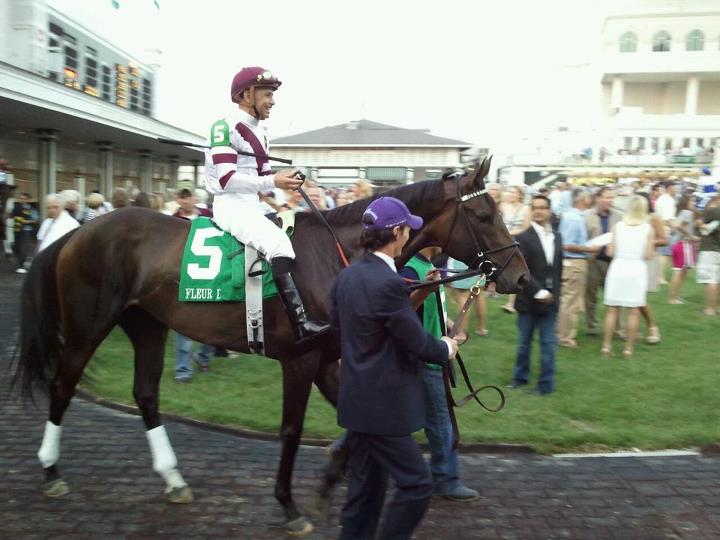
The weekend began with one superstar mare and ended with another. Royal Delta raced in the Sabin (Gr. III) yesterday (Sunday) afternoon for her first start since winning the Breeder's Cup Distaff Ladies Classic last fall. Royal Delta has been riding a peak since last spring (I like to think it began with her romp in the Fleur de Lis at Churchill Downs last June, which my husband and I were fortunate enough to see in person) and I was hoping that she was still riding this peak for the Sabin.


Royal Delta in the paddock before the June 2012 Fleur de Lis

Royal Delta nearing the finish in the Fleur de Lis


Standing tall, she is a long-bodied mare, finely sculpted, with a slender Edward Troye neck and high, beautiful head with a broad flat forehead, straight profile, and eyes bright with intelligence. She is well composed within herself, except when sneaking playful nips to her pony in the post parade. She has matured since 2011, her three-year-old year, and now clearly sees the sport for the game it is. She can stalk or she can speed, and she glides along with a low-slung, ground-eating gallop, her knees bounding high, her neck straight, her ears pricking at the sight of the long, empty homestretch before her. Does she know the roar of the crowd, the shaking of the grandstand, is for her? I have no doubt.
 
To Royal Delta, racing is an art, and she has fast become my favorite artist to watch. Yesterday she looped Gulfstream Park with that long, low-slung gallop of hers as if going for a pleasure stroll through the park. But one only had to look five lengths back to her hard-driving competitors to realize that Royal Delta was not out for a stroll, but in a race. It was also a relief that she won, for she is now headed to Dubai for another crack at the World Cup, following the same path she took last year. The only difference is, a not-yet-mature Royal Delta lost last year's Sabin to the very good Awesome Maria before finishing 9th in the World Cup. Hopefully this year's trip across the ocean will yield better results.

Most racing fans are familiar with Baffert's 1998 Triple Crown contender, Real Quiet. By Quiet American, out of Really Blue (by Believe It, a son of In Reality), Real Quiet is heavily influenced by Tartan Farm's masterful breeding. He also came closer than any other horse since 1979 to winning the Triple Crown. Unfortunately, he died in 2010, but not before siring the brilliant sprinter Midnight Lute (out of the Dehere mare Candytuft), who was also trained by Bob Baffert. Racing fans from the 1998 era are also familiar with Baffert's champion filly, Silverbulletday. Her wins include the Breeder's Cup Juvenile Fillies, Ashland Stakes, Kentucky Oaks, Black Eyed Susans, Monmouth Oaks, and Alabama Stakes. Retiring with 15 wins from 23 starts, she was hailed as one of the top fillies of the 1990s.

These horses are three of the better ones that Hall of Fame trainer Bob Baffert has had in his barns, and over the weekend they came together to produce a trio of three-year-olds to watch--all also trained by Mr. Baffert. Midnight Lucky, by Midnight Lute (out of Citiview, by Citidancer) impressively broke her maiden upon her first try on Saturday. Then yesterday--Sunday--two horses by Midnight Lute and out of daughters of Silverbulletday won at Santa Anita. Govenor Charlie (yes, that is spelled accurately) broke his maiden in his second try--his dam is the unraced Silverbulletway, by Storm Cat. Two races later, Shake It Up won the San Vicente (Gr. II), a Kentucky Derby prep race. Shake It Up is out of the unraced Silver Bullet Moon, by Vindication (a gone-too-soon son of Seattle Slew).

It's been nearly 15 years since I heard much about Silverbulletday, and to have her announce her presence so clearly over the weekend brought back memories. You can see her page on the Hall of Fame here.

 Lastly, Rachel Alexandra has remained in serious but stable condition over the weekend, which is as good news as you can expect. Her veterinarians are encouraged by her progress. I hope she can continue on the upswing and eventually make a complete recovery.